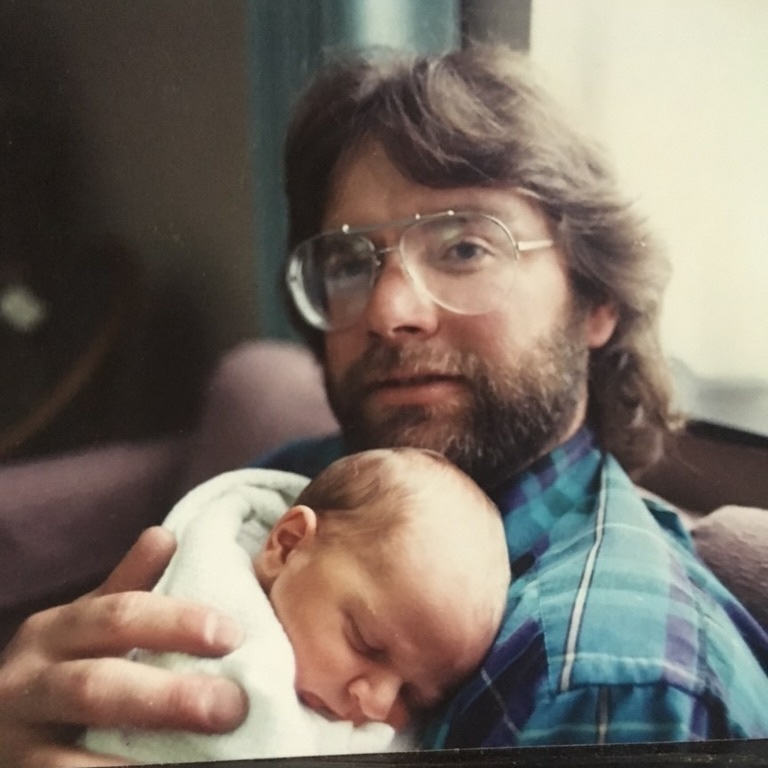
Dad's Eulogy
I’ve been meaning to share this for a while now. On October 5th, 2024, I said goodbye to my dad, Daniel Russell. I gave this eulogy surrounded by the people who loved him. Sharing it here feels like one more way to honor him — to let his story reach a little further, last a little longer.
We’re gathered here today, October 5th, to celebrate the life of Daniel Russell. Though I’ve thought about these words for a decade, I never truly imagined this day would come. As we say goodbye, we find ourselves in the Jewish High Holidays: a time that reminds us of life’s fragility and preciousness. While I’m not a practicing Jew and neither was my dad, it feels meaningful that today, we reflect on his life, which was shaped by that similar awareness of impermanence and the importance of living fully in the time we have.
The Jewish High Holidays, call us into an annual encounter with the deepest truth: life is precious and precarious, and never to be taken for granted. The rituals and liturgy of this season are designed to awaken us from our death-denying slumber and invite us to sit with the reality that we all hover dangerously close to the very edge of life.
The season begins with Rosh Hashanah, the Jewish New Year, and culminates with Yom Kippur, where you “rehearse” your own death – by wearing white, like the shroud you’ll be buried in; by not eating or drinking; by immersing yourself in the memories of loved ones who have passed. The phrase “Who will live and who will die” is repeated, not to punish ourselves, but to empower us to use the time we have to live with humility and grace.
These days celebrate another year together with the reminder that next year some of us may be gone to the annals of time. But today, we are here together. Today, of all the days we could possibly live on this spinning rock heated by a melting star, we find ourselves amongst one another. And today, we remember the life and love and soul of Daniel Mark.
On October 27, 1953 Daniel was born to Wauna and Barde Russell. The second of four siblings: Nancy, Mary, and Don.
My father, as his siblings would no doubt affirm, was a true ‘momma’s boy.’ He adored her, and her spirit stayed with him throughout his life. When her husband passed, he lingered at the farm, his presence a balm for her grief. As she aged, her body surrendering to time’s unyielding hand, my father stood by her side, day after day. She called him her “little Danny boy”, a name as soft as the love it held.
Just as he adored his mother, he also carried a reverence for his father. He marveled at his father’s intellect, his unwavering stoicism, the quiet strength that seemed to hold the world steady. He would speak with a boyish pride, remembering how handsome his dad was, hats tilted just so, cigarettes smoldering, holding the essence of the cowboy my father had once dreamed of becoming.
He admired his father’s strength and wisdom, which shaped him into the man who wanted to build something enduring. Something that would stand the test of time.
Through all of my dad’s strength, he never hid the ache of loss, the grief that never truly left him after his parents’ passing. In his final weeks, there was a refrain, a soft certainty: “I’m not afraid. I have no fear of death. I know my mom and dad will be there, waiting for me.”
A wise friend once said “all anyone gets is a lifetime”.
Dad spent his lifetime with a stoic devotion to a true love; working with his hands. He was an artist both literally and figuratively, and a bit of a perfectionist. He spent thousands of dollars and countless hours collecting and refurbishing audio equipment all in the pursuit of “finding the perfect sound” – an echo of his need to find harmony in all things.
His common refrain before any project was, “If you’re going to do it, do it right”. For him, this wasn’t just about brick and mortar, but about the sacred act of creation itself. He believed that what was built with care, with intention, should stand the test of time, lasting not just years but generations. His hands didn’t merely shape the material world; they restored what had been forgotten, breathing life back into what others had abandoned, finding love in the work of making things whole again.
While he was truly a jack of all trades, with hands calloused from working, his real vocation was being a husband and a father. He joked about hoping for a daughter so he could have more time to himself, but he fully embraced fatherhood, and I was never far from his side as he shared all the things he loved with me. In teaching me how to use tools, fix things, and care for those around me, he wasn’t just showing me tasks – he was laying the foundation for the man I would become.
The first projects we worked on together were simple ones—little honey-dos for my mom. But in those moments, I learned so much more than how to hammer a nail or cut a straight line. I learned what it meant to take pride in your work, to care deeply for the people you love, and to give your best in all things.
Dad loved giving tours of our constantly renovated home which he often called “a diamond-in-the-rough”. He would point out certain details that he worked on and go “so June can- this” and “So June doesn’t have to- that.” And that was the kind of spirited man he was—one we call a mensch: A man who takes care of his business and takes care of others.
We affectionately referred to him as “Dan the Man”. I have spent my entire life watching and trying to model that man. He didn’t just set the standard. He is the standard. The kind of man I hope, with time and effort, I can one day become.
While he taught me how to do almost everything I know, one craft he perfected was the art of love.
June Marie was the love of his life.
My parents story has always felt like a love story for the ages. When I asked my dad to write down some stories, he shared one about how they met in the summer of 73. So, in his own words, here it goes:
“I first met my future wife in the summer of 1973, the summer of love. I had just graduated and was living with two of my friends, Hal Gausman and Terry Claussen. Hal I had known forever, growing up in the same neighborhood. Terry and I met while working at Hastings Equity Grain Bin. There we put together water tanks for livestock and worked with metal presses and cutters, and I became the principal tank solderer. It kept my hands busy, it was noisy, and many of the jobs were dangerous, but we were young and looking for a paycheck. With mine, I bought a brand new Honda 500 four motorcycle.
The young social life in 1973 consisted of school games and dances, local talent or a mildly famous rock and roll concert. And there were always parties. It was the beginning of the sexual revolution, the age of Aquarius, and the end of the Vietnam war. My generation was learning to stretch our wings in a rapidly changing world.
Back then we had no internet, no Facebook, no TikTok, or instagram. No cell phone in our pocket, just the wall phone in the kitchen at home (no privacy!). We communicated by heading to the strip — the main north-south road through town. We would pile into a car and cruise up and down all evening, communicating with our friends on where to meet or where the parties were, or just the latest gossip about whatever. We were truly living! It was a blast!
One evening I was leaving the local Pizza Hut located right on the strip, that my friend Larry Rouse managed at night. I would often stop in after work and have a couple beers and pizza while shooting the breeze with Larry. I went outside and was saddling up on my motorcycle when a small VW beetle pulled up next to me full of rowdy loud girls making a pit stop at the Pizza Hut. The driver was a girl nicknamed Ernie who was known to be wild. The front passenger was Peg Sneller, a sweetheart of a gal and she and I were in homeroom together. I asked Peggy if she wanted a ride, while her friends were busy and she quickly replied ‘no, but my friend June would love a ride!’ About that time this skinny brunette I had never seen before popped out of the back of the beetle. June was visiting from Iowa and she flashed me a big smile and a shy hello.
I couldn’t say no, so I handed her my helmet, mounted my bike, instructed her where the foot rests were, and told her to hold on so I didn’t lose her at the stoplight. Well, I don’t remember how long we cruised or what we talked about, but I do remember how tight she held me. Her shyness was gone and we conversed and laughed, and I gave her some hard acceleration thrills which only increased squeezes. It was fun. We saw her group on the strip and I dropped her off and we said our goodbyes, but not before I got her number. We had our first date at a local steakhouse which I suggested to impress her, and it worked!
It was a few broken hearts and promises and even years later that I knew I wanted to marry her… I think we both had some growing to do, I know that I did.
A few summers later, I was working for the railroad with Dean Pittman who was my go-to partner in crime. I was watching my folks lake house in idol-wyld right outside of Hastings. Being the responsible stewards that we were, Dean and I figured we should throw a party. Unbeknownst to me, Deano saw June while he was on a beer run and told her to come through.
When she arrived I was so excited to see and talk to her… we conversed most of the night and I missed the entire party. I asked her out again and she obliged. I think we had spent some time apart and knew it was empty time, with no one else that mattered. That was when true love stirred within me once again, and she still holds me in that spell to this day. I will die in her arms…”
And he did.
My Dad asked my mom to marry him with a modest ring in front of smith falls along the Niobrara. Two young penniless hippies, they settled in Lincoln and built the foundations of a rich life together.
Their love was a structure of its own; built on years of laughter, sacrifice, and resilience. Even in the hardest moments, they were building something stronger than either of them could have known. Their love was their greatest masterpiece, a bond that would endure despite all odds.
When asked what the most romantic moment of his life was, my father described how he and my mom tried for 13 years to have children. The first 12 were spent convincing him.
My parents packed their bags and took everything they had – emotionally and financially – to Birmingham, Alabama. There, they met with Dr. Honea (Ho-nee), who guided them through the delicate process of IVF. It’s the most clinically tame version of “the birds and the bees” you can imagine: my mother’s eggs were retrieved, my father’s sperm carefully introduced, and an embryo created in a lab. But the science is only part of the story. IVF, for all its precision, ultimately depends on a leap of faith—the hope that, after implantation, those few critical days will pass, and life will take root. You wait, suspended between possibility and uncertainty, caught in the balance of what modern medicine can do and what it simply can’t guarantee.
During this time, my dad described them walking through Birmingham, finding a park to picnic in and watch the fountain for a while. A vacation from the unabridged. A moment for them to take a look at each other. To take stock, to see what they were made of.
His eyes welling with tears, he described how she had never been more beautiful to him than in this moment. How incredible it was to see her moving through the world and channeling her all her love and good vibes into manifesting this new life in her womb. And how grateful he was for her wisdom of inviting him into the journey of fatherhood. He said he couldn’t help but fall in love with her all over again— how she was someone he simply couldn’t live without.
The price of loving someone is having to lose them. The price of living is having to die.
Months ago we faced the very real understanding that his death was imminent and he was losing the ability to withstand the intensity of the treatments. We’ve known his disease would eventually kill him. A decade ago he went under the knife and had pieces of his body removed in an attempt to contain it. The prostate cancer had already mounted its insidious invasion into his bone marrow. The marrow, which produces blood cells, was slowly overtaken by malignant cells, leading to severe anemia, immune system collapse, and uncontrollable bleeding.
Nothing will radicalize you quite like watching someone you love die from cancer. It strips away all the noise, all the things that don’t matter. And it leaves you with questions you cannot answer. I often wondered if it is a blessing or a curse to know you’re close to death. The word “blessing” is derived from the Anglo-Saxon word for blood: bledsian. And contained in its meaning is the understanding that there is no great blessing without sacrifice. And perhaps vice versa.
There is something extraordinary about receiving blood from a stranger. Someone you will never meet sits in a chair for an hour and gives a part of themselves so that your father can live another week. The blood carries no name, no memory, no allegiance. And yet it arrives in his veins and does the work of keeping him alive. Lincoln spoke at Gettysburg of ground consecrated by blood, earth made sacred not by ceremony but by what was sacrificed into it. I think about that. I think about how blood moves between bodies, between strangers, between the living and the dying. How it refuses to stay with any one person. Whitman knew this when he wrote:
“I bequeath myself to the dirt to grow from the grass I love, if you want me again look for me under your boot-soles.”
Life is not a thing we possess but a thing that passes through us, connecting us to everything that came before and everyone still to come. Bledsian: To consecrate by religious rite. To make holy. To give thanks.
Before the end, I thanked him for what I believe was the greatest gift he ever gave me: his unwavering, unfiltered pride in me, no matter what I did. That was his defining trait as a father – his belief in me was constant, a steady pulse. It didn’t matter how small or trivial the accomplishment was, he always found a way to let me know how proud he was. Sometimes, he didn’t even need to say it; I could just feel it in the way he looked at me.
In these last few weeks, I’ve come to realize that this wasn’t just a gift he gave to me, it was something he gave to everyone he loved.
He had this remarkable ability to believe in people, to see them fully and hold them in a kind of reverence. He had a way of shining a light on what made each person special, elevating them with that same quiet strength. It wasn’t just me, look at all of you here today. And he absolutely adored my wife, Sarah. He believed in her in a way that only a father could. In his eyes, she could do no wrong, and he made sure she knew it. That was his gift—to make people feel seen, cherished, and capable.
His pride became the bedrock of my own strength, allowing me to walk paths without knowing where they led, to endure when there were no promises. It shaped me into a better man.
The bible tells the story about Daniel, a devout jew living in Babylon. Daniel rises to power in the king’s court which made his babylonian peers envious. They manipulate the king into issuing a decree that forbids praying to anyone but the king himself. This is not an issue for the Babylonians, for they don’t believe in god. But Daniel, committed to his faith, prays to God as always, fully aware that it could cost him his life.
When Daniel is caught, the king, bound by his own law, sentences him to be thrown into a den of lions. But here’s the twist: Daniel’s faith, not fear, defines him. He spends the night in the lion’s den, unharmed, protected by divine intervention. The next day, he’s pulled out, and his accusers meet the fate they had set for him.
Our Daniel has been in his own lion’s den for the last decade, and I can tell you that I have watched him in it. I have watched him sit through treatments that left him unable to eat, unable to sleep, unable to do the things his hands were made for. He lost weight, lost mobility, lost time he should have had. But he never lost his faith in this life and in the people who filled it. I watched him, after all of that, ask me how my day was. Ask about Sarah. Ask about the baby. Fall in love with my mother again every morning.
He was dealt a terrible hand, but he never felt sorry for himself, never became bitter with the world. He spent his time in the den the same way he spent his time everywhere else: thinking about the people he loved.
So much of my dad’s story feels like it should be a tragedy. But his final gift to me was the revelation that it is not.
Myself and Sarah, our unborn child, my mom in the back holding it all together. We were his reason for living. His legacy is more than what he built with his hands; it’s what he built in the people he touched. Those are the stones that will last, even as time moves on.
When faced with the world’s unfairness, he never stopped building, never stopped sowing the seeds of something lasting, because he believed in the strength of what he was creating. His suffering was real, a heavy thing to witness, but the love and lessons he gave us have shaped something far more enduring: a structure built of resilience, compassion, and belief, stronger than any single hardship he faced.
In my hardest moments, I will call upon his strength and that quiet, steady resolve that defined how he moved through life. His love will continue like a steady rain: subtle, persistent, and nourishing those who need it most.
And I know I will see him again – in the eyes of my son, when he learns about the bravery of Daniel in the lion’s den.